
 Translate
Cedar River Trail
About the trail
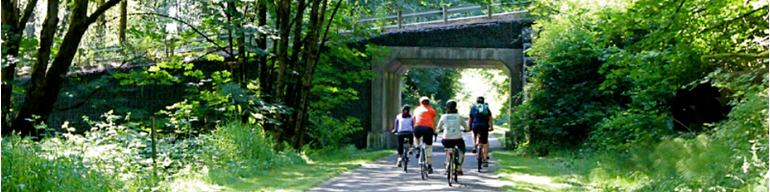
The Cedar River Trail (CRT) follows the Cedar River from where it enters Lake Washington in the City of Renton upriver to the community of Landsburg at the boundary of the City of Seattle’s Cedar River Watershed. At 17.4 miles in length the CRT is a paved, off-road trail for the first 12.3 miles, and features a soft surface for the last five miles.
The trail follows a historic railroad route between the river and State Route 169, and passes through or near Renton, Maplewood, Cedar Mountain, Maple Valley, and Rock Creek. It offers views and access to Lake Washington, downtown Renton, Cedar River Park, Maplewood Golf Course, Ron Regis Park, Cedar Grove Park, and Maple Valley.
The CRT also provides excellent views and access to the Cedar River along its length. Between Renton and Maple Valley the CRT is popular with bicyclists and skaters and provides both recreational and non-motorized commuting opportunities.
At Maple Valley the trail intersects the Green-To-Cedar Rivers Trail, which runs through central Maple Valley, then continues to the more secluded Rock Creek area and onto Landsburg in a wooded river valley. This soft-surface segment is popular with off-road bicyclists, joggers, walkers and equestrians.
Parking is provided at both ends of the trail, and at numerous locations along its length.