For questions about the King County CSO Control Program, please contact Karen Huber.

Wastewater Treatment Division
King Street Center
201 S. Jackson St., Suite 505
Seattle, WA 98104-3855

Get Directions to our office location in Seattle, Washington.

Real Time CSO Notification

Green Street, Portland, ORRain CisternGrasscrete, Shoreline, WABioswale, Seattle, WAParking Lot OHSU, Portland, OR

Green stormwater infrastructure for combined sewer overflow control

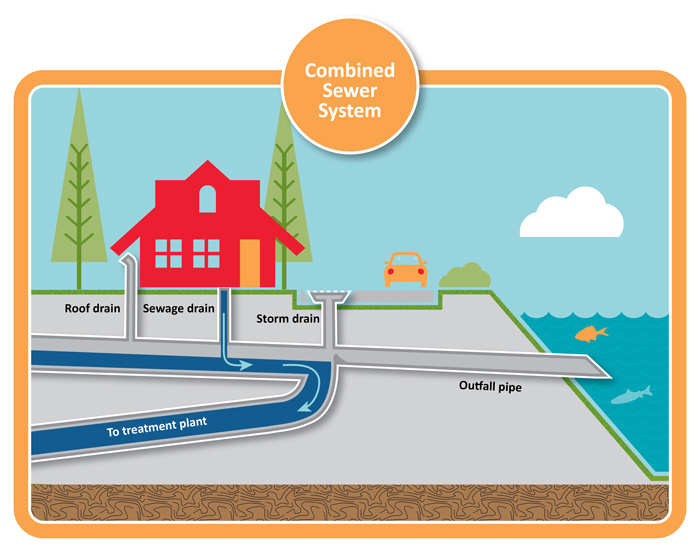
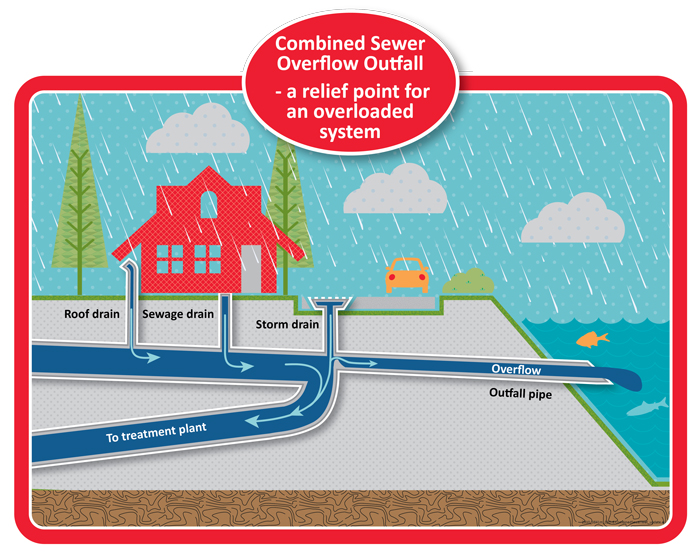
The oldest parts of King County’s sewer system were designed to carry stormwater from streets and roofs as well as wastewater from homes and businesses to the nearest water body. Today, that water is sent to a wastewater treatment plant. During heavy rains, however, the pipes can fill and overflow into waterways. These are called Combined Sewer Overflows or CSOs. King County’s Wastewater Treatment Division plans to control all of its 38 combined sewer overflow (CSO) sites to an average of no more than one overflow per year by 2030, as required by regulatory agencies. Green Stormwater Infrastructure (GSI) is one method that could be used to reduce peak flows of stormwater and groundwater into the combined sewer system (also called “demand management”).

What is green stormwater infrastructure (GSI)?

The concept of green infrastructure originated in the conservation field. In this context, large forests, wetlands, greenbelts, and so forth—all part of the natural environment—are viewed as infrastructure because they support essential ecosystem functions. The term is increasingly being used to refer to engineered infrastructure at a smaller scale in relation to green stormwater infrastructure practices such as rain gardens and green roofs. These practices make use of soils and vegetation, in combination with other approaches such as rain barrels and permeable pavement, to infiltrate, evaporate, capture, and reuse stormwater.

In addition to helping reduce CSOs and the amount of untreated stormwater that finds its way to surface water, green stormwater infrastructure facilitates natural processes that recharge groundwater, preserve baseflow in streams, moderate impacts to water and air temperature, and protect hydrologic and hydraulic stability. Other names for green stormwater infrastructure include low impact development (LID) and natural drainage.

Learn more about natural drainage systems locally, around Puget Sound and nationally.

Why do GSI projects?

Seattle has been on the leading edge of GSI for more than a decade. Simply put, it’s using green solutions to help reduce overflows by allowing stormwater to infiltrate slowly into the ground and cutting the volume of stormwater entering the combined sewer system.

The goal is to use GSI to reduce CSOs. Green solutions control CSOs by slowing, detaining, or retaining stormwater so that it does not carry runoff into nearby waterways. This reduces the volume and timing of flows into the system.

King County’s CSOs are regulated through the West Point Treatment Plant’s National Pollutant Discharge Elimination System (NPDES) permit. The U.S. Environmental Protection Agency (EPA) has delegated management of NPDES permits in Washington State to the Washington State Department of Ecology (Ecology).

EPA states (external link) that green infrastructure can be both a cost effective and an environmentally preferable approach to reduce stormwater and other excess flows entering combined sewer systems in combination with, or in lieu of, centralized hard infrastructure solutions. EPA encourages permitting authorities to use GSI approaches, where appropriate, in NPDES permits and long-term CSO control plans.

EPA has issued guidance (external link) on employing green infrastructure for CSO control.

Back to top of page.

What are some GSI techniques?

  • Green Roofs consist of shallow layers of growing medium, low-growing vegetation, subsurface drainage, and a waterproof membrane.
  • Roof disconnection removes water that flows from a roof through a downspout to a combined sewer and redirects it to some other location. It is not considered a GSI technique, but may be combined with “green” features such as rain gardens.
  • Bioretention involves dispersed small scale landscape features designed to attenuate and treat stormwater. These features are typically vegetation-filled areas, such as rain gardens and swales, with a drainage mechanism, often located in parking lots, median strips, or streets. Bioretention is an element of Seattle’s Residential RainWise program (external link) on private property and natural drainage systems on neighborhood streets.
  • Permeable pavement allows rainfall to penetrate the pavement into a porous material that retains stormwater before it enters a combined sewer, limiting or removing the effects of the stormwater on the sewer system. Permeable pavement is not suited for high traffic areas.

Back to top of page.

What is required for GSI to work for CSO control?

While GSI can provide benefits in stormwater control, neighborhood enhancements, water quality, and reduction in CSOs, there are several factors that should be considered for successful implementation of GSI for CSO control.

  • Enough sources of stormwater - streets, roofs, and other impervious surfaces - that can be disconnected from the sewer system to limit CSOs and meet state standards for no more than one overflow per year on a long term average. If GSI alone cannot control the entire volume added traditional infrastructure may need to be constructed to insure compliance with regulations for CSO control.
  • Land area available for GSI. Rain gardens, swales, and other GSI elements require sufficient space for installation. GSI features may be sited in existing planting strips, in parking lots, on private property, and in other existing space.
  • Appropriate soils and topography. GSI benefits from flat areas where water can infiltrate into soils. Steep slopes and poorly draining soils are not recommended for GSI techniques.
  • Community support and participation for GSI projects. GSI projects, like other sewer and stormwater projects, has an effect on the community during and after construction. In some cases participation by homeowners is necessary to complete certain GSI techniques.

Back to top of page.

Related information

Duwamish Water Quality Improvement Fund

King County Executive's Recommended CSO Control Plan, June 2012
King County Executive's Recommended CSO Control Plan
, June 2012

Nearby natural drainage systems you can visit
 

Potential areas in Seattle that King County is recommending for GSI

Learn how King County evaluated GSI techniques as part of the Puget Sound Beaches CSO Control Projects

For more information on Seattle Public Utility’s stormwater control programs

For more information